



War Did Not Kill Reading in Idlib: Culture and Intellectual Life in the City of the Last Revolution
Khaled walks through the aisles of the library, moving his eyes between the shelves in search of the novel he has been waiting for—a book the library owner promised to provide him
He is a university student who frequents several libraries in Idlib, northern Syria, aiming to find books that enrich his intellectual and literary taste, in addition to books that support his studies in the Arabic language department in Idlib, which—like other Syrian cities—suffered from decades of cultural blockade
The desires of readers, with their diverse intellectual interests, have become increasingly accessible in Idlib after the absence of the censors that the Assad regime imposed for many years on various types of books, especially those with an Islamic theme
Despite its harshness, the war played an important role in diversifying intellectual activity and the emergence of certain literary genres at the expense of others
Arabic teacher Mahmoud Al-Nimr told Al Jazeera that the long war in Idlib left both negative and positive effects that cannot be ignored. He said: “The number of readers has noticeably decreased because people are preoccupied with the war and its news on one hand, and the psychological pressures weighing on the residents of the region on the other, not to mention the low social conditions in northern Syria and people’s focus on earning a living”
On the positive side, Al-Nimr added, “Books glorifying the leader, which used to dominate library shelves, are no longer present today. Many figures who were prominent in the intellectual scene before the revolution—through their continuous efforts to polish the regime’s image—have also disappeared.”
In contrast, many previously marginalized or censored voices have emerged, and books with religious content have increased significantly. According to Al-Nimr, the deprivation imposed by the Assad regime on this type of work contributed to its wider circulation during the war years, including works by Ibn Taymiyyah, Sayyid Qutb, and Ali Al-Tantawi.
Al-Nimr takes pride in his collection of books and volumes, which he has been collecting for over thirty years, particularly works he spent time and money to acquire during his travels across Arab countries, such as In the Shade of the Qur’an by Sayyid Qutb, which he smuggled from Beirut out of fear it would be confiscated at the time.
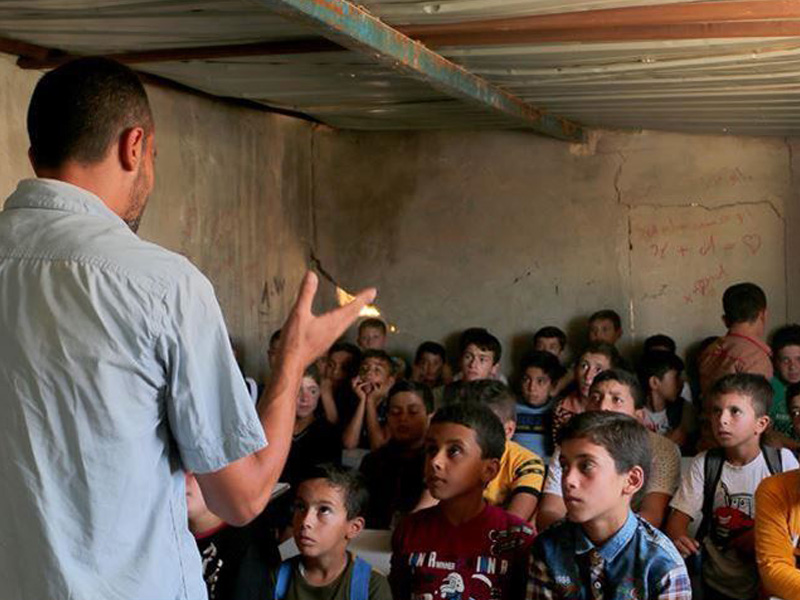
The teacher owns more than 500 books and volumes in his library and reads approximately ten books per month. He is committed to spreading culture and literature in the community by providing his students with the most important books and novels suitable for their age.
Leave a Reply
Your email address will not be published. Required fields are marked *
Search
Category